
In 2012, IATA member airlines adopted the foundational standard for New Distribution Capability (NDC) as Resolution 787, “Enhanced Airline Distribution.”
This resolution introduced key concepts such as a Product Offer and an Order process.
Before that, airlines often relied on third parties to decide how airline products appeared and were sold through travel agency channels. So, the goal of NDC was straightforward: give travel agencies (and their customers) access to richer airline offers, including better content and the ability to support personalization, which older protocols limited.
DOT approval cleared the path in the US
After IATA filed the resolution, the US Department of Transportation first issued a tentative decision in May 2014 and then finalized approval in August 2014, with safeguards around privacy, competition, and the voluntary nature of the standard.
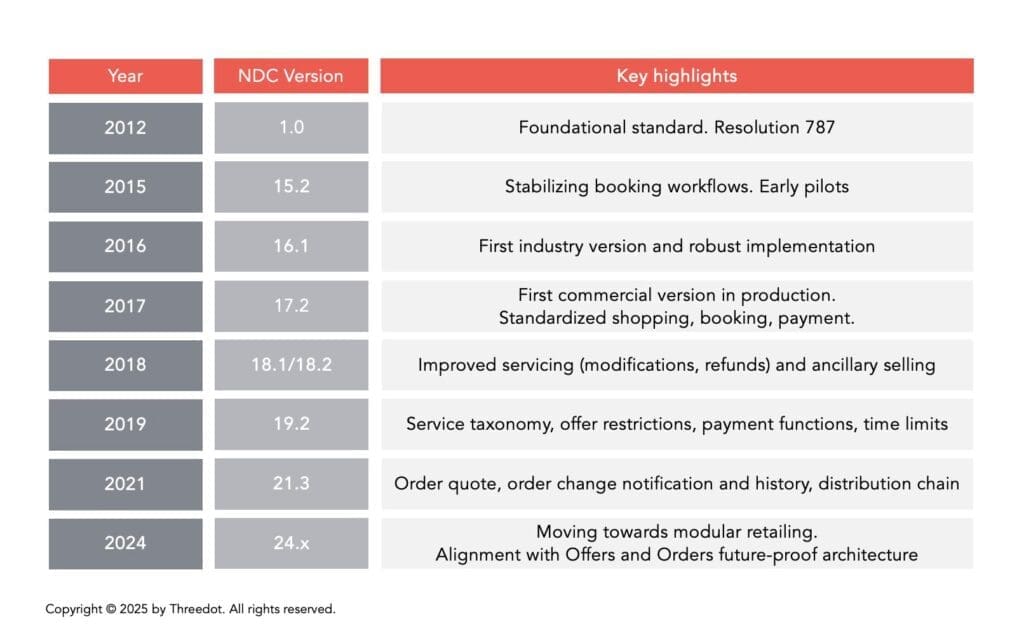
How NDC message versions evolved
Once the foundation was in place, IATA and industry stakeholders iterated on the NDC schemas. As a result, each release improved messaging, workflows, and technical maturity.
Early schemas such as 15.2 and 16.1 helped the industry test and stabilize the approach.
The versions most airlines and vendors focus on today
Many airlines and vendors use one of these versions (or they plan migrations between them):
17.2 (baseline for industrialization)
NDC 17.2 became a key baseline because the industry viewed it as stable enough to support broader adoption.
(Release date for certification: Sept 1, 2017.)
18.1 and 18.2 (stronger order/servicing foundations)
These releases expanded capabilities and helped the ecosystem move toward more robust servicing patterns.
(18.1: Mar 1, 2018; 18.2: Sept 1, 2018.)
19.2 (more functional coverage)
19.2 added capabilities in areas such as payment-related functions and other enhancements.
(Release date for certification: Oct 22, 2019.)
21.3 (“golden release” alignment)
IATA and many stakeholders describe 21.3 as a convergence point that the value chain can work toward.
In practice, 21.3 supports deeper order capabilities (including areas such as order history / notification patterns) and helps build consistency for modern retailing workflows.
The new 24.x generation
IATA describes “24.1 and beyond” as a new generation of schemas that builds on learnings and improves support for Offers and Orders.
This is why 24.x is more than a technical refresh: it is part of making the standard easier to scale across more complete retailing and transaction needs.
What this means for airlines
Many airlines still operate on 17.x or 18.x. However, airlines that want to push modern retailing faster often find newer schemas (such as 21.3 and beyond) better suited to advanced workflows and stronger consistency. To discuss more, please reach out to hello@threedot.io.
For more insights on retailing transformation, follow Threedot.